
The Skilled Ambition Signature Methodology
The PIVOT Framework: A Career Change Model Built for Non-Technical Women Moving Into Tech
Five phases. One sequence. No coding required. This is the exact system behind every successful pivot in this community, laid out in full so you can see how it actually works before you take a single step.
What Is the PIVOT Framework?
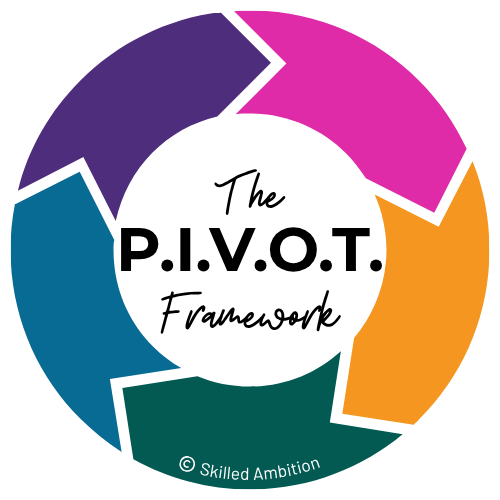
The PIVOT Framework is a five-phase career change model I created to help non-technical professionals move into non-technical roles at tech companies, using the skills, experience, and knowledge they already have.
Each phase builds on the one before it. The framework takes a career changer from confused to clear, and from frozen to finally moving, without requiring a technical background, a certification, or starting over.
P Personal Assessment
I Investigate Opportunities
V Value Proposition Rebrand
O Outreach & Network Engagement
T Tactical Applications
The Problem PIVOT Was Built to Solve
Most non-technical women trying to move into tech are not short on effort. They have updated the resume. They have cleaned up the LinkedIn profile. They have applied to dozens of roles. What they are missing is not more applications. It is a strategy that puts those applications in the right order.
The typical approach looks like this: rewrite the resume first, apply everywhere, hope something lands. It skips the two decisions that actually determine whether any of it works: which skills are the ones worth leading with, and which single role to aim at. Without that groundwork, a resume rewrite is just a better-formatted guess.
That is the core belief behind PIVOT. Career pivots are not a confidence problem and they are not a volume problem. They are a sequencing problem. Get the order right, and the rest of the process (the resume, the LinkedIn profile, the applications, the interviews) gets dramatically easier, because it is finally aimed at something specific.
Where the Framework Came From
I built the PIVOT Framework from three places at once: my own pivot into tech, what I've observed working in the market, and what has actually produced results for the women I coach.
In 2016, I was a customer service trainer at an insurance company. I was good at my job. I was also underpaid and underrecognized, with no idea that tech companies were hiring for the exact work I was already doing, just under different job titles and at significantly higher salaries.
Then I met someone who was an executive at a tech company. Not an engineer. Not a coder. A brilliant woman with a non-technical degree and background who had built a very respectable career inside tech. That one encounter cracked the door open for me. Not a plan. Not a strategy. Just proof that someone with an unexpected background could make it in this industry.
I pivoted from insurance into tech and have continued to grow inside the industry since. The PIVOT Framework is the strategy I wish I had been handed at the start, built out further with every client I've coached through the same move. Holly pivoted from customer service into health tech using it. Alicia went from classroom teacher to tech startup. And many others have leveraged parts of this method to make real progress. The framework is the throughline across all three pivots: different backgrounds, same sequence.

The Five Phases at a Glance
Each phase has a planned outcome. None of them are optional, and none of them work in isolation. The framework is designed to be completed in order, because each phase depends on the clarity produced by the one before it.
P
Phase One
Personal Assessment
This is where most people are tempted to skip straight to the resume. PIVOT starts here on purpose. Before you can position your experience for a specific role, you have to know what you're actually working with, and most professionals have never been asked to look.
What Happens in This Phase
This phase starts with a structured look at your own skills and strengths, pulling evidence from your work history, feedback from people who know how you operate, and your own strongest moments on the job, so your sense of your value is built on evidence instead of guesswork.
From there, you widen the lens beyond the obvious. Most people only account for their core skills: communication, leadership, problem solving. This phase pushes you to also account for the industry knowledge, tools and processes, and customer or problem familiarity you've built up over your career, the layers that often carry the real competitive edge for a career changer.
You close the phase with a clear profile of the environment, responsibilities, and conditions you're actually looking for, so you have a standard to measure roles against instead of chasing whatever shows up next.
You leave this phase with language for your own value and a clear standard for what you're pursuing. That clarity is what makes every later phase possible.
I
Phase Two
Investigate Opportunities
This is the phase that prevents the "spray and pray" job search. Instead of applying broadly and hoping something sticks, you narrow to a single target role and get to know it in depth before you touch your resume.
What Happens in This Phase
This phase translates your background into the language of real job postings, so what looks like an unrelated career on paper actually reads as directly relevant. Things like "classroom management" become "stakeholder management and facilitation." "Patient scheduling" becomes "workflow coordination and operations."
From there, you research your top contenders for real: what people in the role are actually doing day to day, based on real postings and real profiles, not assumptions about what a job title means. You weigh your options honestly, strengths and friction points included, so the role you land on is a deliberate choice, not a default.
This is also where you get honest about the gap between where you are and what the role actually requires. Not everything you need is something you already have, and that's expected, not a red flag. Part of this phase is naming what still needs to be learned, so it becomes a deliberate part of your plan instead of something you discover halfway through an interview. Right now, that increasingly includes some level of comfort with AI, since it's showing up inside almost every non-technical tech role. You don't need to become technical to close that kind of gap. You need to know it's there.
You leave this phase with a single, well-researched target role and a clear-eyed list of what to build next. Everything from here forward is built around it.
V
Phase Three
Value Proposition Rebrand
This is the phase most people try to start with. PIVOT places it third on purpose: you cannot write a targeted resume without a target, and you don't have a target until Phases P and I are done.
What Happens in This Phase
With a target role locked in, you develop a clear, confident statement of your value: your target role, your top transferable skills, and the outcomes you tend to produce, distilled into a single case for why you belong in the room.
Your resume gets rebuilt from the ground up as a positioning document, not an autobiography. Written to the role you're targeting, not to your past, with every bullet built around impact instead of task lists. Your LinkedIn profile gets the same treatment: headline, About section, and experience rebuilt to read as a match for where you're headed. You also run a quick pass on your public digital footprint, so everything findable about you online supports the direction you're going.
This is also where the gaps you named in the last phase get a home. If there's something you're still building toward, whether that's a skill, a certification, or a comfort level with a new tool, your rebrand can speak to that growth in progress instead of pretending it doesn't exist. A career changer who's actively closing a known gap reads as someone in motion, not someone underqualified.
You leave this phase with application materials that make your case instead of just listing your history.
O
Phase Four
Outreach & Network Engagement
Most job seekers treat networking as an afterthought or skip it entirely. PIVOT treats it as a phase with its own methodology, because most roles are never filled exclusively through cold applications.
What Happens in This Phase
This phase gets your existing network working for you. You map out who you already know, where they sit relative to your target role and industry, and who's a connection or two away from people who could help, so outreach starts with people who already have some context on you instead of cold strangers. This isn't about collecting connections. It's about seeing the opportunity that already exists inside the network you have.
You learn how to reach out with messages that are short, specific, and human, built around genuine interest rather than an immediate ask. And you start showing up on LinkedIn with a light, consistent posting rhythm, because visibility and credibility build the same way relationships do: over time, not overnight.
You leave this phase with a network that's actually working for you, and a public presence that signals you're serious and already in motion.
T
Phase Five
Tactical Applications
By this point, you know your target role, your materials are aligned to it, and your network is active. This final phase is about executing the job search itself with intention.
What Happens in This Phase
This phase turns the job search itself into a system instead of a scramble. You learn the difference between submitting an application and hoping, and what it actually takes to get in front of the people who make hiring decisions, before and after you apply.
You also learn how roles get filled before they're ever posted publicly, and how the work from the earlier phases sets you up to be part of that conversation. From there, it's about setting measurable goals, tracking your progress, and keeping a sustainable weekly rhythm, so the search stays a system you can maintain, not a sprint you abandon after two weeks.
You leave this phase with a repeatable process for making every application count, and a plan for sustaining it until you land the role.
Why the Order Matters
The PIVOT Framework is designed to be worked in sequence, and that's not a stylistic choice. Each phase depends on the one before it:
1 Phase P (Personal Assessment) identifies your transferable skills.
2 Phase I (Investigate Opportunities) maps those skills to the right role and surfaces what still needs to be learned to compete for it.
3 Phase V (Value Proposition Rebrand) translates your experience into that role's language.
4 Phase O (Outreach & Network Engagement) builds the relationships that support the move.
5 Phase T (Tactical Applications) gets you applying with a focused, strategic approach.
Skip ahead and you're building on a foundation that isn't there yet. Rewrite a resume before you've chosen a target role, and you're guessing at what to emphasize. Start networking before you know what you're asking for, and your outreach has no direction. The sequence is what makes each phase actually work.
The Philosophy Underneath the Framework
The PIVOT Framework rests on a belief that shapes everything inside it: most non-technical women pursuing a pivot into tech are not underqualified. They are underrecognized. The gap is not a capability gap. It's a translation gap, and underneath that, an identity gap.
You don't need to become someone new to make this move. You need to see clearly what you already have and learn how to say it in a language the market recognizes.
That's why the framework starts with Personal Assessment instead of a resume template, and why every phase is built on evidence rather than motivation. Confidence here is not manufactured through affirmations. It's built from proof: peer feedback, documented history, real research, real outcomes.
That doesn't mean there's nothing left to learn. It means you start from what you've already proven, not from zero. Closing a real gap is part of the process. Pretending you have no gaps is not the same thing as being qualified.
Frequently Asked Questions
Do I need a technical background to use the PIVOT Framework?
Do I have to complete the phases in order?
What if I don't know what role I want yet?
How is this different from generic resume or LinkedIn advice?
Can I move through the phases on my own?
Ready to see where you fit?
Start Here: Get Oriented Inside the Skilled Ambition Lab
The Skilled Ambition Lab is a free space to get your first real read on where you fit in tech, connect with other women working through the same pivot, and take your first steps into the PIVOT Framework, without trying to figure it out alone.
Join the Lab Free